Seven Years of Overstaying: Is a UK Partner Visa Still Possible?
Can an applicant with a serious history of overstaying, and a previous unfounded asylum claim still obtain entry as a UK partner visa?
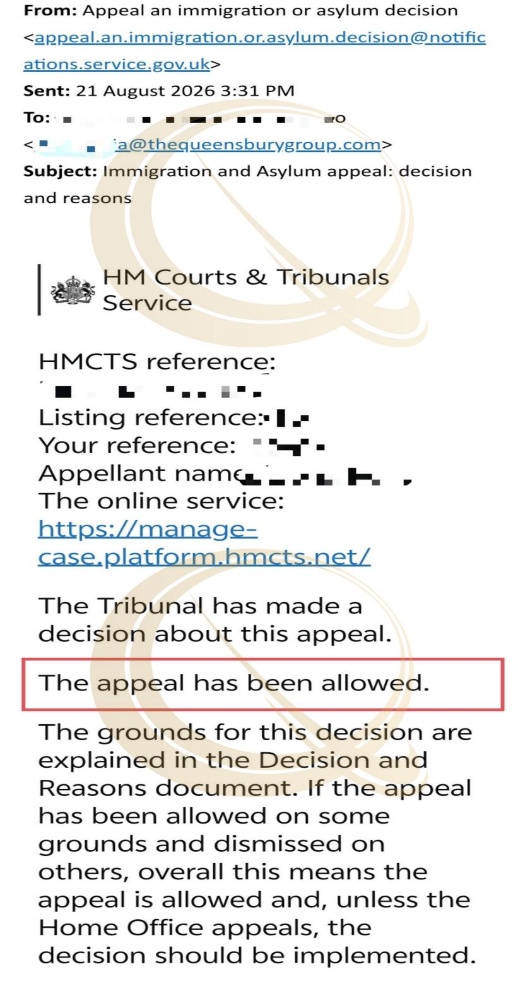
A few days ago, a long standing Appendix FM Partner appeal at the Immigration and Asylum Tribunal represented QCL Associates LLP and our learned friend Eric Fripp at the 36Group finally gave a verdict that our client and his partner has been waiting more than 2 years for receive. APPEAL ALLOWED!
This was far from an ordinary partner visa case. From the applicant voluntarily leaving the UK as the advice of an Immigration Tribunal judge and returning to China to make a fresh application, to the Home Office refusing the application again, resulting in another length appeal process marred by multiple adjournment, lack of judges and an unexpected listing issue immediately before the hearing. The entire process lasted for more than two years.
What makes this case particularly significant is not simply who ultimately won. More importantly, the judge had to weigh an important question: where a person has previously breached the Immigration Rules but later leaves the UK voluntarily and reapplies through the correct procedure, how should that subsequent compliant conduct be treated in law?
That question ultimately became central to the successful outcome of the appeal. Serious Adverse Immigration History
The applicant lawfully entered the UK in 2016 with a valid visit visa. However, after his visa expired, he did not leave and remained in the UK as an overstayer for approximately seven years.
He later made an asylum claim with the advice of an unscrupulous legal advisor. Much to our client’s regret, the asylum materials contained false statements. He had simply followed the poor legal advice given to him at the time and that the account advanced in the asylum claim was untrue
From the Home Office’s perspective, this was therefore plainly not a case involving only a short period of overstaying. The lengthy period of unlawful residence, the false statements in the asylum claim and the applicant’s previous immigration history all became important factors in the later refusal.
At the same time, however, the applicant’s circumstances changed. He changed legal advisers and sought to regularise his position on the basis of his genuine and subsisting relationship with his British partner. A relationship which had genuinely flourished over time.
In the earlier appeal proceedings, the genuineness of the relationship had already been accepted, and the financial and English-language requirements were not in dispute. The real issue became whether his previous immigration misconduct was still sufficient to justify refusing his partner visa application.
An important turning point in the case was when our decided not to remain in the UK and continue seeking ways to delay his departure. In spring 2024, he decided to do the right thing and stop repeating past mistakes. He left his British Partner and returned to China to apply for entry clearance whilst maintaining their long distance relationship. Our client then made a fresh UK partner visa application from China through the proper route. He chose a route that was neither easy nor cost-free: he left the UK and reapplied from overseas. But that did not bring the matter to an end. The Home Office refused the application again.
This time, the refusal was not focused on whether the relationship was genuine, nor on the financial or English-language requirements. The central issue was suitability: whether the applicant’s immigration history was sufficiently serious to justify refusal.
The Home Office relied on a number of allegations, including an alleged illegal entry to the UK in 2020, prolonged overstaying, the use of applications said to be frivolous in order to frustrate immigration control, and alleged failure to report and absconding from immigration control.
The real question in the case was therefore not:
“Are they a genuine couple?”
Rather, it was:
Where a person has seriously breached the Immigration Rules in the past, but later leaves voluntarily and begins complying with the proper immigration process, are those past mistakes still sufficient to justify refusing the visa?
That was the central issue in the appeal.
After the appeal entered the First-tier Tribunal, it did not proceed immediately to substantive determination. The Home Office repeatedly failed to file its Review within the time limits directed by the Tribunal. The case was eventually listed for a hearing. Our client, his witness and Counsel were all prepared. However, when the parties attended Taylor House for the first hearing, the case was not substantively heard.
This now mean potentially another relisting and waiting further weeks and months. We therefore had to continue following up and pushing for the case to be relisted.
After months of waiting for another court date to be listed, the most precarious moment came immediately before the second hearing. At around 10 p.m. on the night before the hearing, we checked the court listing again and identified an apparent problem with the case arrangements. Had the issue not been spotted until everyone arrived at court the following morning, the hearing could very well have been adjourned again.
For an applicant who had already waited for more than two years, the consequences need little explanation. We therefore prepared an urgent complaint and supporting representations that same evening, and attended Taylor House early the next morning to pursue the issue in person.
After more than three hours at the Tribunal and some stern words exchanged by our counsel with court staff, the court ultimately arranged for a judge to hear the case remotely.
Once the substantive hearing began, the First-tier Tribunal judge considered the Home Office’s allegations one by one. The judge found that the applicant had in fact lawfully entered the UK in 2016 with a valid visit visa. Although the asylum materials contained a false account of an alleged journey in 2020 through Russia and Poland and entry to the UK in a lorry, there was an important logical distinction:
The fact that a person tells a false story does not mean that the events described in that false story actually happened.
In other words:
A “false statement” and proof that the events described in that false statement actually occurred are two entirely different things.
The judge therefore did not accept the Home Office’s allegation that the applicant had illegally entered the UK in 2020.
The judge also analysed the Home Office’s other allegations individually and did not simply attribute every adverse factor to the applicant merely because he had a serious history of immigration breaches.
This is perhaps the most important part of the judgment. The judge did not minimise the applicant’s past conduct. Approximately seven years of overstaying was a serious adverse factor, and the significant false statements in the asylum claim also had consequences. However, what the judge did, was to see past this, to how our client tried to right his wrongs.
The applicant later left the UK voluntarily rather than continuing to remain unlawfully. He paid for his own return to China and then reapplied from overseas through the correct procedure.
At this point, the judge identified an important public-policy consideration:
There is a legitimate public interest in encouraging a person who has no right to remain in the UK to leave voluntarily and regularise his or her immigration position through the appropriate procedure.
The judge therefore considered that, although previous misconduct does not disappear merely because a person leaves voluntarily, subsequent corrective and compliant conduct is a material consideration when deciding whether a discretionary ground for refusal should continue to be applied.
The Home Office had already accepted that our client and his British partner were in a genuine and subsisting relationship. The relevant financial requirements were met; and the English-language requirements were met.
The Tribunal further found that important parts of the Home Office’s case on suitability had not been established. The judge ultimately found that:
“The appellant meets the requirements of the Immigration Rules for entry clearance as a partner.”
After more than two years of proceedings, the appeal was finally allowed.
What lessons can be learned?
The most important lesson from this case is not simply that “someone with an adverse immigration history can still obtain a partner visa.”
Every case has different facts, evidence and legal issues. What this case demonstrates is a different principle: past immigration misconduct matters, but it does not necessarily determine a person’s future forever.
Particularly in complex immigration cases, the law may need to consider both what happened in the past and what the applicant did afterwards, especially where a substantial amount of time has passed.
The message here is that voluntary departure is not necessarily an admission of defeat or failure. In some complex cases, it can instead be an important step towards regularising status and rebuilding a route to lawful entry.
We are not suggested that everyone with a history of overstaying, asylum claims or false representations should simply follow the same course. However, we are suggesting that more migrants need to be brave like our client and stop prolonging their departure by filing meritless applications to remain in the UK. There are some legal advisors who put their best interest in front of the clients and so will not advice a client to stop making meritless applications and leave the UK because there pockets are simply being lined. Though there are also many clients we have met who think it’s shameful to return home and feel embarrassed to go back to face family members.
Throughout the case, we continued to push when progress was possible; we identified issues as soon as they arose; and when the procedure went wrong, we did everything we could to resolve the problem. We challenged the Home Office for failing to comply with court directions. It may have been a long wait, but we waited alongside our client, never failing to answer any concerns they had, or charge them extra just because the matter was prolonged far beyond our exceptions.
Our aim was simply, it was to ensure that a case which still had a proper prospect of success did not lose that opportunity simply because of procedural delay or administrative difficulty.
We are particularly grateful to our client for their unwavering trust throughout this process. When the proceedings repeatedly stalled and the timetable continued to stretch, our client gave us the space to keep pushing the case forward. It was our responsibility to monitor every procedural stage and do everything possible to remove obstacles to progress.
If you have a complex immigration appeal which has been pending and would like to seek advice on your options in your are an overstayer in the UK in a relationship with a settled person or a British Citizen, get in touch for a no frills, free of charge conversation with our advisors.
Very good company. I got my residents visa in UK through Queensbury.
— Hayder Alawsy
1 / 5
The counselling is wonderful.
I am very grateful for the cooperation and responses to my queries.
— Mahesh Kumar
2 / 5
Second time working with Pav, she’s been brilliant as always!
I would recommend the firm to anyone seeking immigration advice.
— Customer
3 / 5
I would totally recommend QCL
I would totally recommend QCL associates dealing with my ILR application in such a proffesional and timley manner, i would have no hesitation in using your services again.
I Really want to thank Pav and Nur for their professional advice which made me clear all my doubts and quiet happy with the positive outcome.
Very best wishes and thank you
Smit
— Smit
4 / 5
I am so amazed by Nur work
I am so amazed by Nur's work. I would recommend The Queens Bury Group to anyone who needs assistance with their UK paperwork. 5 stars is not enough.
— O Lawrence
5 / 5
Contact our team to chat about your needs
If you have an enquiry, reach out to us to schedule a confidential
consultation to discuss your case.We'll listen to your concerns and provide an initial assessment.
Call us, email us or use our online enquiry form below.
The QCL Associate LLP website (the "website") is provided by QCL Associates LLP ("Queensbury") a limited
liability partnership (registered number OC412213) practising English law. QCL Associates LLP is
Authorised and regulated by the Solicitors Regulation Authority ( 669878 ). A list of our members of the
LLP can be found at the registered office and on Companies House.